

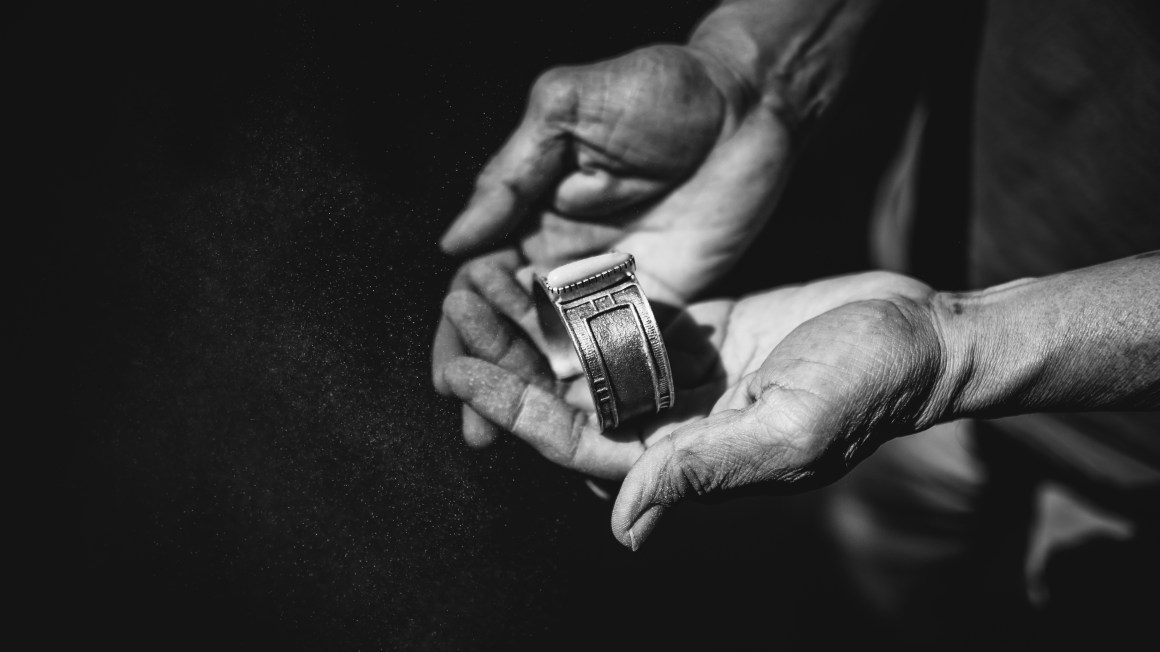
Host Varun Nayar sits down with journalist Kathleen Sharp to discuss her Pacific Standard feature story “The Theft of the Gods,” which covers the theft and illegal trade of religious objects created by the indigenous Hopi community in the Four Corners region of the United States.
Below, an excerpt of the feature, the full version of which is available here:
It was a hot summer day on the Hopi reservation in Arizona, with sunlight slanting onto jagged vermillion cliffs. A swarm of boys and girls were playing atop the plateau known as Second Mesa, their faces aglow in the late afternoon light. Suddenly, one of them spotted two white strangers skulking around. It was 1978, and not many white men showed up in this isolated part of northeastern Arizona. Fewer still made it to the stony outcrop below Shungopavi village where the children played.
The strangers were furtively hunting for rare pottery and other exquisite items that are coveted by collectors who are willing to pay dearly for them. A few days of hunting could fetch as much as $15,000 (which would be about $60,000 today).
The men had been searching for hours when rays from the setting sun illuminated the mouth of a small cave partially covered by rocks. One of them climbed up to it, removed some rocks, and peered inside. As his eyes adjusted, he saw four wood figures, each about a yard long. Three of the carvings were arranged tenderly on a bed of feathers, their heads resting on a log, while the fourth leaned against the cave wall as if guarding the others. The figures seemed almost animate, with expressive eyes, open mouths, and sturdy limbs. The man knew immediately that he’d stumbled onto something precious, and called to his companion. This cache could be worth a fortune.
The two intruders could have stolen the relics then and there. But there was the matter of the children. So the thieves left and returned the following night.
Special thanks to the Investigative Fund of the Nation Institute for supporting Sharp in her reporting of this story. To receive new episodes as soon as they go live you can subscribe to The Edit on iTunes and Soundcloud. Please leave a review or a comment; it helps us learn more about what our listeners want to hear on the show.