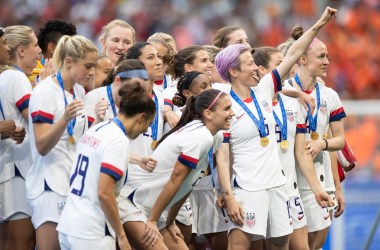
Both the men's and women's national teams have disputed the USSF's claims.
The United States Soccer Federation has argued the women generate less revenue—a claim that is not supported by the current evidence.
The most important reads from our coverage of unions, driverless tech, urban gentrification, and more.
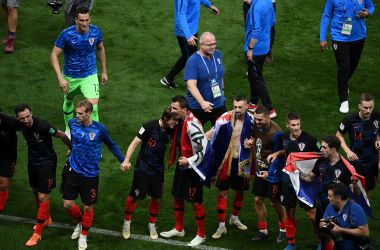
Croatian football players celebrate after winning the Russia 2018 World Cup semi-final against England.
Brazilians have become increasingly disenchanted with soccer as political scandals continue to cloud the country's news cycle.
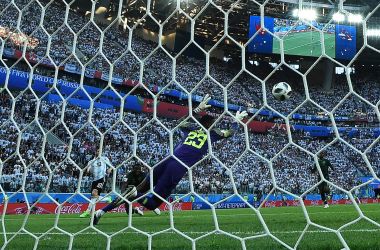
Argentina beat Nigeria 2–1 in their final qualifying game at the 2018 World Cup.
We spoke with four economists about Russia's claims of a World Cup-related financial windfall. They were all skeptical.
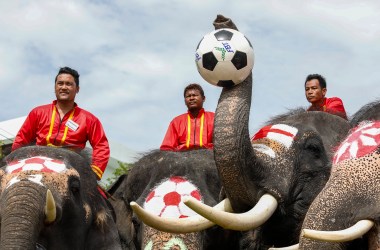
Elephants participate in a football game to kick off the World Cup fever as part of an anti-gambling campaign at the ancient Thai city of Ayutthaya on June 13th, 2018.
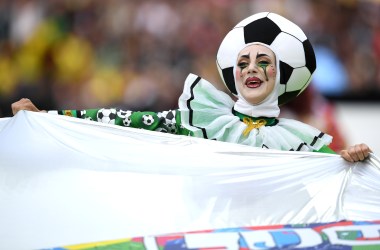
A dancer looks on during the opening ceremony prior to the 2018 FIFA World Cup Russia Group A match between Russia and Saudi Arabia at Luzhniki Stadium on June 14th, 2018, in Moscow, Russia.
The latest entry in a special project in which business and labor leaders, social scientists, technology visionaries, activists, and journalists weigh in on the most consequential changes in the workplace.
A round-up of news and research on stadium spending gone wrong.
For many, the 2014 World Cup and 2016 Olympic Games represent missed opportunities to tackle health problems and inequality.
The most famous teams from the Netherlands were glorious failures—at least to outsiders. In a nation that often prized an ideal over tangible results, some might have to come to terms with a new team that's two games away from the country's first World Cup title.
In a country where immigrants haven't always been welcome, politicians champion Die Mannschaft as an integrated model of diversity.
Sometimes a national team looks nothing like the country it represents.
The number of immigrants in a country doesn't seem to have an effect on how diverse its national team is. If anything, it appears that ethnic and racial minorities get pushed toward soccer.
The idea of Italian identity has always been a weak one, and the brief, oncer-every-four-years flirtation with the national team just brings those issues into sharper focus.
The massive, multicultural, multiracial nation initially struggled to find a uniting identity—until everyone started playing and watching the sport brought over by the British.
This post recognizes it is adding to the noise—but remains hopeful that it also says something valuable about the future of media coverage.
Most domestic American players don't make that much money, but with new collective bargaining negotiations coming up, a good performance from the U.S. National Team could help to change that.
A rumored death threat from Mussolini, what was ostensibly an on-field boxing match, and an egregious handball doubling as payback for the Falklands War.
As soccer picks up fans and followers in the U.S., entrepreneurs are betting that they’ll be able to make a lot of money off of a sport that’s already enormously popular elsewhere. Will their bets pay off?